© Copyright European Union - 2026
The EUR 90bn loan by the EU to Ukraine is now practically finalised. This seems a good moment to reflect on what public affairs practitioners can learn from the process.
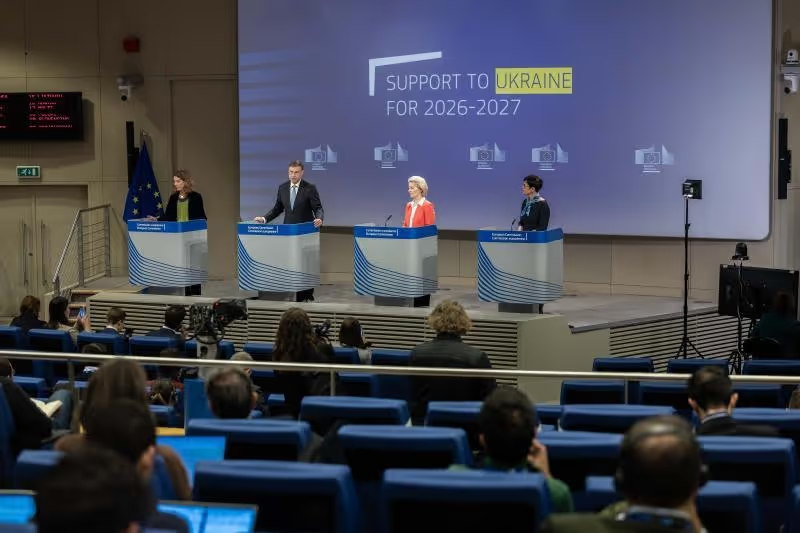
The European Council meeting of 18 December 2025 decided to grant a EUR 90 billion loan to Ukraine financed through common EU borrowing on the financial markets. That solution was preferred over seizing the EUR 185 billion Russian assets held by the Belgian financial institution Euroclear. These assets, property of the Russian central bank, remain frozen under the current EU sanctions following Russia’s invasion of Ukraine in February 2022.
Various commentators saw this outcome as a political and diplomatic victory for Belgian prime minister Bart De Wever, who had strongly opposed the seizure of the Euroclear assets for fear of legal and financial consequences that Belgium could not bear on its own.
For public affairs practitioners, the Euroclear saga is a fascinating case that reveals all the elements of a successful campaign to achieve desirable outcomes of the EU decision making processes.
The genius of the EU Treaty
Decisions by the EU are based on the procedures defined in the EU Treaty. This may seem a slow and convoluted process for outsiders, but it is essential to ensure that the common interest of the EU – supporting Ukraine – and the national interests of 27 Member States, with governments that have different political compositions and a different history that feeds their positioning, can be aligned to result in a common decision. EU decisions are not dictated by a “strong man,” but by applying the Treaty mechanism to keep the Union together. As in previous demanding situations, the genius of the Treaty did its work and Member States overcame divisions to obtain essential results.
Keep your eyes on the goal.
Belgium never put into question the EU’s central goal: ensuring the financial support for Ukraine to defend itself against the Russian aggression. It was essential to eliminate any doubt about achieving that outcome, in order to focus the debate on the best solution to get there. The common EU interest prevailed and that allowed for Member States who started from different positions to find common ground for the loan option. That strategy proved to be conducive to the result: the discussion was not about how to accommodate Belgium’s concerns against Germany’s attitude adverse to the creation of common EU debt. It was about reaching consensus on how to continue to support Ukraine. Rejecting the common goal because of disagreement about the way in which to achieve it is not a productive strategy. Offering better solutions to achieve commonly agreed objectives in the EU proves to be the winning strategy.
Build a strong narrative.
European debates require solid arguments. The Belgian government presented very thorough legal, economic, and political arguments, in great detail, on why the seizure of assets would be bad. At the same time, it developed, with the help of the Commission, all the good reasons for the common loan option. It was not the relative power of Belgium that won the debate, but the strength of its narrative.
Belgium diplomacy ensured political support from other Member States, like France and Italy, for its solution. That was essential to bring together a majority in the Council, even if Germany initially objected to creating further common EU debt. The direct and discreet engagement with EU capitals, well in advance of the crucial Summit, produced the necessary backing. Belgium was not alone with its concerns.
Political feasibility
Member States like Hungary, Czechia, Slovakia, did not wish to contribute financially to the cost of the common loan before it could be recovered from Ukraine after a future peace agreement – calculated at about EUR 3bn per year. Based on the decision making procedure that required unanimity in the Council for a common EU loan, diplomatic efforts resulted in the acceptance of an exemption for the Member States who didn’t wish to chip in on the costs, while convincing them of not blocking the loan by breaking the consensus. It may not look like the most elegant expression of unity, but smart procedural and political engineering delivered the wanted result. If you like sausages, you do not want to see them made.
Deliver consistent messages constantly.
During the months preceding the 18 December 2025 EU Council meeting, the Belgian government remained prudent in its communication. Any message repeated the fundamental legal, economic, and political arguments against the seizure of the Euroclear detained assets. It ensured that the debate remained focused on the substance, not on the differences between Member States. No countries or governments were attacked in the messages to avoid political bad blood. At national level, the prime minister repeated his resolve to prevent the seizure solution. In messages to the EU and beyond, the government highlighted and reiterated the unbearable risks for Belgium to be solely liable for potential Russian retaliation in case of expropriation and the potential loss of trust in the international financial system. The message was clear: seizing the assets would create major problems for all, not just for Belgium. The shared interest in finding a different solution to continue to support Ukraine prevailed.
Once the decision taken, the Belgian prime minister was modest in his declaration. No gloating from his side, just a restrained observation that “rationality had prevailed”.
What does this mean for EU public affairs practitioners?
When you want to influence EU decision making to address serious concerns with a proposal:
Seek a better solution to achieve the goal set in the interest of the EU. Develop a strategy based on process and timeline.
Do your homework properly. Analyse the possibilities to intervene offered by the procedures based on the Treaty.
Do not just reject a proposal (“No is not an amendment”), but come forward with a legally, economically, politically underpinned alternative.
Extensively develop your arguments against a proposal and in favour of a better solution and share them with those who have the power to decide.
Reach out to the EU capitals, put your network at work. Build a majority in your support. The twenty-six other Member States are your prime audience.
Do not just attack those who start with opposite views. That alienates the politicians who you want to convince.
Have a sustained communications plan in place. Stick to the substance of the issue. And repeat the messages time and time again.
Modesty in success only enhances your reputation.


